
Born in a clock-makers family, Bernard RICHARDS was quite logically led to study at the Horology and micro-mechanics Schools of Paris, and to be filled in turn by the love of traditional clock and watch making.
This knowledge enabled him to create his own watch, a unique model, reflecting his passion for mechanical sports, and more particularly for the automobile competition. Thus was born the GP44, very first model of the BRM collection, a watch which was immediately adopted by customers eager for authenticity and originality.
1958 : Bernard RICHARDS was born in Paris.
1972 : The RICHARDS, initially a jewellers family, decides to give up jewellery and to turn towards clock and watch making.
1974 : Bernard RICHARDS enters the horology school of Paris.
1976 : He turns towards the micromechanics school of Paris.
1978 : he chooses to enter the gemstone school of Paris.
1981 : He decides to improve his knowledge of the sorting through diamonds (more particularly as regards their colour and quality) thanks to a stage.
1983 : Bernard RICHARDS joins the family business and develops a series of clocks, watches, pens, lighters for huge international luxury groups.
1986 : Creation of the Bernard RICHARDS Company, which specialized in machining components for the luxury industry.
1996 : The Bernard RICHARDS company moves to new premises and invests in brand new sophisticated numerical machines.
2002 : BRM is founded, and 6 supplementary numerical machines are bought.
2005 : BRM moves, thus doubling its premises, and stops producing for the big luxury groups.
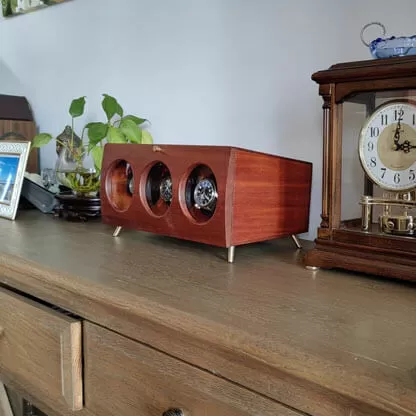
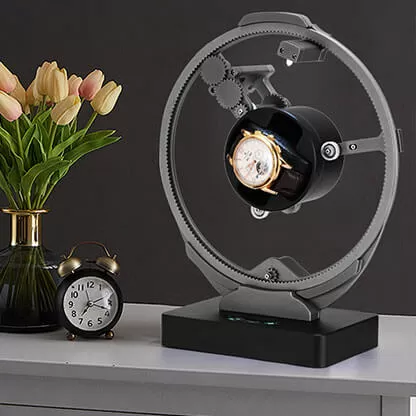
Most B.R.M. watch self-winding movements can be wound properly by most watch winders. Usually B.R.M.'s self-winding movements need to rotate 650 - 800 revolutions per day, and most of them can be wound clockwise. So please take some time and like to choose a cute clockwork that suits you and your watch.
Definitions:
- 《CW》 - Clockwise winding direction;
- 《CCW》 - Counterclockwise winding direction;
- 《Both》 - Combined mode (Clockwise + Counterclockwise);
- 《–》 - Undefined;
| MODEL, DESCRIPTION | MOVEMENT / CALIBER | WINDING DIRECTION | TURNS PER DAY (TPD) |
|---|---|---|---|
| 3MVT-52 | 2671 | Both | 650 |
| CR-44 | 7750 | CW | 800 |
| CT-48 | 7753 | CW | 800 |
| G45-T | 7753 | CW | 800 |
| GP40-B | 7753 | CW | 800 |
| GP40 l - OR | 7753 | CW | 800 |
| GP- 44 Automatic Chrono | 7753 | CW | 800 |
| MT-51/ 49 N Automatic Chrono | 7753 | CW | 800 |
| MTD-53/35 N Automatic | 2671 | Both | 650 |
| MRT-48 | A07.161 | CW | 800 |
| PMT-40/43-N | 2824-2 | Both | 650 |
| S-44 Automatic Chrono | 7753 | CW | 800 |
| SCR-48 | 7753 | CW | 800 |
| SCR-CN Racing | 7753 | CW | 800 |
| SCR-CO Racing | 7753 | CW | 800 |
| SCR Racing | 7753 | CW | 800 |
| SP-44-BN-Gold | 7753 | CW | 800 |
| V5-25 | 2671 | Both | 650 |
| V6 Automatic | 2824-2 | Both | 650 |
| V6-44 Automatic | 2824-2 | Both | 650 |
| V7 Automatic | 2824-2 | Both | 650 |
| V7-38 Automatic | 2824-2 | Both | 650 |
| V8 Automatic Chrono | 7753 | CW | 800 |
| V8-44 Automatic Chrono | 7753 | CW | 800 |
| V9 Automatic Chrono | 2894-2 | Both | 650 |
| V11-41 | 7753 | CW | 800 |
| V12 Automatic Chrono | 7753 | CW | 800 |
| V12-44 Automatic Chrono | 7753 | CW | 800 |
| V12-44 Automatic Chrono Gold | 7753 | CW | 800 |
| V14 Automatic Chrono | 7753 | CW | 800 |
| V14-44 Automatic Chrono | 7753 | CW | 800 |
| V16-46 | 7753 | CW | 800 |
| V18-48-TN | 7753 | CW | 800 |
| WL-44 OIR Automatic | 2671 | Both | 650 |
If you could not find your watch model (or caliber) in this table, you may determine your B.R.M. winding mode on a trial basis. You should select the combined winding mode (CW+CCW) and the minimal number of turns per day (TPD). Then place your watch into the watch winder box and check after a few days how accurate your watch shows the time. If it runs behind, it is necessary to increase the number of TPD by one step.


