


The Rolex Crown: Logo Meaning, Crown Types & Everything You Need to Know
The word "Rolex crown" means two very different things — and understanding both is essential for any serious collector or enthusiast. It refers to the brand's world-famous coronet logo, and also to the physical winding crown — the small knob on the side of every Rolex watch. This guide covers both in full detail.
1. What Is the Rolex Crown?
In everyday watch conversation, "Rolex crown" can refer to one of two things:
- The Coronet (logo crown) — the five-pointed symbol printed on every Rolex dial, embossed on buckles, and stamped on packaging.
- The Winding Crown — the physical mechanical crown on the right side of the case, used to wind the movement and set the time and date.
Both are inseparable from Rolex's identity. The logo communicates prestige and heritage; the mechanical crown communicates engineering mastery. Together, they encapsulate what Rolex stands for.
2. The Rolex Coronet Logo: History & Meaning
The Rolex crown logo — officially the coronet — was first registered as a trademark in 1925, just two decades after Hans Wilsdorf and Alfred Davis founded the company in London in 1905.
The coronet features five distinct points, each traditionally associated with excellence in a specific dimension of watchmaking: precision, quality, waterproofness, self-winding, and aesthetic perfection. Some historians note that Wilsdorf drew inspiration from the shape of a human hand — five fingers symbolising the craftsmanship behind every Rolex watch.
Did You Know
The coronet appears in gold on Rolex's primary logo — a deliberate choice reflecting the brand's association with yellow gold cases and bracelets throughout its history.
The coronet is printed in applied gold lettering directly onto most Rolex dials, not merely printed — it is physically raised above the dial surface. This dimensional detail is one of the first things expert authenticators check when verifying a Rolex.
3. How the Rolex Crown Logo Evolved Over Time
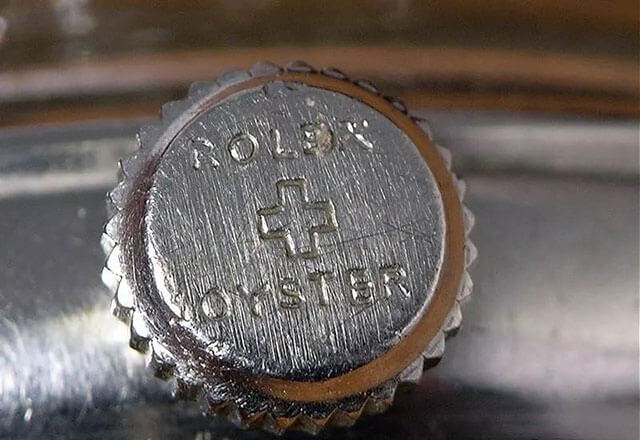
Pre-1960: Crown + Cross Symbol
On vintage Rolex watches made before approximately 1960, you will find an earlier version of the crown logo: the coronet accompanied by a small cross symbol below it. This cross-and-crown combination reflected the brand's Swiss heritage and the influence of ecclesiastical imagery common in mid-century European design. Today, these early dials are highly collectible precisely because of this distinctive marking.
1960s–1980s: Simplification
During the 1960s, Rolex gradually simplified the dial logo, removing the cross and standardising the coronet as the sole emblem. Fonts were refined, and the word "Rolex" itself became bolder and more uniform across all models.
Modern Era: The Refined Coronet
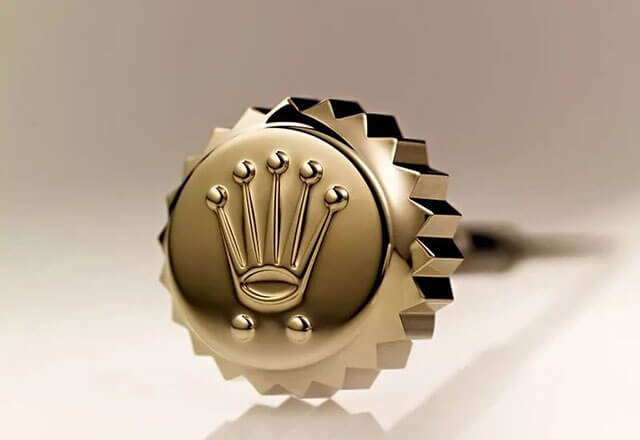
Today's coronet is a refined, precise five-pointed form — clean, symmetrical, and instantly recognisable at any size. It appears on dials, crowns, clasps, buckles, presentation boxes, and all brand communications.
Collector's Tip
If you own a Rolex manufactured before 1960 and can see a cross beneath the coronet on the dial, your watch carries a rare early logo variant that significantly increases its collectible value.
4. The Rolex Winding Crown (Physical Crown) Explained
The winding crown is the small, knurled knob found at the 3 o'clock position on every Rolex watch. It is the primary interface between the wearer and the movement — used to wind the mainspring, set the date, and set the time. On every Rolex, the crown also bears a miniature version of the coronet logo, debossed into the metal.
Rolex calls its winding crown system the Twinlock or Triplock, depending on the model. Both use a threaded, screw-down mechanism to seal the crown against the case — a revolutionary concept Rolex introduced with the Oyster case in 1926.
5. Triplock vs Twinlock: Key Differences
Rolex uses two main crown sealing systems. Understanding the difference helps you choose the right model for your lifestyle.
| Feature | Triplock Crown | Twinlock Crown |
|---|---|---|
| Sealing zones | 3 (triple) | 2 (twin) |
| Water resistance | 300m+ (varies by model) | 100m (10 ATM) |
| Crown diameter | Larger — easier grip underwater | Slimmer — more discreet on dress watches |
| Identifier | Dots at 6, 9 & 12 o'clock on crown | Dots at 9 & 3 o'clock on crown |
| Models | Pro Submariner, Sea-Dweller, GMT-Master II, Explorer II, Milgauss | Dress Datejust, Day-Date, Air-King, Cellini |
| Crown profile | Protects with crown guard lugs | Flush profile, no crown guards |
Quick Identification
To identify your crown type without a manual: look at the sides of your Rolex crown under a loupe. Three dots = Triplock. Two dots = Twinlock. Simple.
6. The 3 Crown Positions & What They Do
Every Rolex crown has three operational positions. Knowing these prevents accidental damage to your movement.
Important: After setting, always push the crown back in and screw it down firmly clockwise until resistance stops. Leaving it unscrewed compromises the Oyster case's water resistance completely.
7. Crown Sizes Across Popular Rolex Models
The physical size of the Rolex crown varies by model family. Professional sport models have larger, more grippy crowns for use underwater or with gloves; dress models have smaller, more elegant profiles.
| Model | Crown Type | Crown Style | Case Size |
|---|---|---|---|
| Submariner (Date) | Triplock | Large, crown guards | 41mm |
| Sea-Dweller / DEEPSEA | Triplock | Extra-large, protected | 43mm / 44mm |
| GMT-Master II | Triplock | Large, crown guards | 40mm |
| Datejust 41 | Twinlock | Slim, no guards | 41mm |
| Day-Date 40 | Twinlock | Slim, no guards | 40mm |
| Explorer I | Twinlock | Medium | 36mm / 39mm |
| Explorer II | Triplock | Large | 42mm |
8. Rolex Crown Care & Maintenance Tips
The crown is the most mechanically vulnerable external component of your Rolex. Follow these best practices to protect it:
Always Screw Down After Use
This is the single most important rule. An unscrewed crown invalidates your watch's water resistance entirely. The Oyster case is only sealed when the crown is fully threaded against the case tube.
Avoid Crown Contact During Sport
Even with crown guards, a hard lateral impact to the crown can bend the stem or damage the crown tube threads. Remove your Rolex — or ensure the crown faces inward — during contact sports and manual labour.
Never Force the Crown
If your crown feels stiff or gritty, do not force it. Sand, salt, and debris can enter the threads and cause corrosion or thread damage. Have it serviced. Rolex service centres will clean and re-lubricate the crown tube as part of a standard service.
Keep Your Rolex Running with a Watch Winder
One overlooked benefit of a quality watch winder is that it reduces unnecessary crown manipulation. When your automatic Rolex is kept wound in a winder, you rarely need to set time, date, or manually wind — meaning less wear on the crown stem and threads over time.
Keep Your Rolex Perpetually Ready
A precision watch winder keeps your Rolex wound, your date correct, and your crown threads protected from unnecessary use. Explore our curated collection of winders designed for Rolex movements.
Silent motors · Programmable TPD · Shop Rolex Watch Winders →


